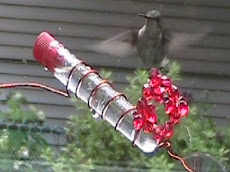
Hummer Foto Feeder™
All Products are Here
2010-04-26
Hummingbird feeder
I just want to tell all you hummingbird lovers you need to go to Jam's e-bay site (merrcomm) and get the Nectar Storage Dispenser Bottle, I just used mine Sunday for the first time and I can tell you it is the best thing to fill all the tubes I have, it is wonderful, I also used the brush set he has on his e-bay site and they really made cleaning up all the tubes and caps so much easier, no more spilled nectar from the measuring cup I had been using, summer is here, yea!! Phyllis


2010-04-21
Hummer News – Vol. 8 – April 2010
With fairly strange, often wet and suddenly warm weather earlier this month, everything around here suddenly seems to be about two to three weeks ahead with respect to trees and shrubs blossoming out. Since my earliest hummer sighting last spring was on May 10th, I used Monday’s unique Massachusetts holiday, Patriot’s Day (when the Boston Marathon is run, starting about 12 miles down the road from me and running right through downtown) to place about 25% of my nectar feeders around the yard. So far no evidence of any visits, but I expect action just about any day now. I hope spring in your area brings an explosion of leaves and blooms, as well as yardfuls of hummingbirds.
Your Visits and Photographs
As always, I remain extremely interested to hear from you about when your visits start or how busy your feeders are. In addition, nothing makes me happier than receiving photos and videos from you as you document the comings and goings of our tiny friends. The blog is always open to anyone that has anything at all they would like to share with the rest of us.
My Broken Record Observation
If you haven’t already done so, now would be a very good time to clean all bird feeders, not only your hummer feeders with a mild, 10% bleach solution and a good rinse before the season begins. For you year round folks, spring would always be a good time to do a thorough clean-up, as well as several other times each year. Anytime that any black residue is building up on any nectar feeder or part, it is essential for the health of your visitors to give everything a good scrubbing.
Product Feedback Always Welcomed and Encouraged
I am especially interested to hear any feedback from recent customers who have purchased any MerrComm hummingbird products, now including the Hummer Foto Feeder™ the Hummer Stik™ hand held feeder, a Nectar Tube cleaning brush set or Nectar storage and dispensing bottle. I want all of these products to be the best I can make them and your feedback is a very important component to in helping me accomplish that.
Our blog awaits and welcomes you…
Please visit your blog Hummingbird Haven and better yet, please jump in. I have just posted a new video from southern California and will be putting up the fact and instruction sheets for all the current products. If you’ve lost the email inviting you to be a fully enabled post author, just drop me an email and I will send a new one. Just reply to that invitation and join the fun. Find the blog here: http://hummerhaven.blogspot.com/
Happy Hummers and a big warm welcome to Spring!
Copyright 2010, Merritt Communications, Inc. – All Rights Reserved
Your Visits and Photographs
As always, I remain extremely interested to hear from you about when your visits start or how busy your feeders are. In addition, nothing makes me happier than receiving photos and videos from you as you document the comings and goings of our tiny friends. The blog is always open to anyone that has anything at all they would like to share with the rest of us.
My Broken Record Observation
If you haven’t already done so, now would be a very good time to clean all bird feeders, not only your hummer feeders with a mild, 10% bleach solution and a good rinse before the season begins. For you year round folks, spring would always be a good time to do a thorough clean-up, as well as several other times each year. Anytime that any black residue is building up on any nectar feeder or part, it is essential for the health of your visitors to give everything a good scrubbing.
Product Feedback Always Welcomed and Encouraged
I am especially interested to hear any feedback from recent customers who have purchased any MerrComm hummingbird products, now including the Hummer Foto Feeder™ the Hummer Stik™ hand held feeder, a Nectar Tube cleaning brush set or Nectar storage and dispensing bottle. I want all of these products to be the best I can make them and your feedback is a very important component to in helping me accomplish that.
Our blog awaits and welcomes you…
Please visit your blog Hummingbird Haven and better yet, please jump in. I have just posted a new video from southern California and will be putting up the fact and instruction sheets for all the current products. If you’ve lost the email inviting you to be a fully enabled post author, just drop me an email and I will send a new one. Just reply to that invitation and join the fun. Find the blog here: http://hummerhaven.blogspot.com/
Happy Hummers and a big warm welcome to Spring!
Copyright 2010, Merritt Communications, Inc. – All Rights Reserved
2010-03-11
Hummer News – Vol. 7 – March 2010
Hummer News – Vol. 7 – March 2010
Time to prepare all your feeders and nectar tubes
If you haven’t already done so, now would be a very good time to clean all bird feeders, not only your hummer feeders with a mild, 10% bleach solution and a good rinse before the season begins. For you year round folks, spring would always be a good time to do a thorough clean-up, as well as several other times each year. Anytime that any black residue is building up on any nectar feeder or part, it is essential for the health of your visitors to give everything a good scrubbing.
MerrComm Product Feedback Welcomed and Strongly Encouraged
I am especially interested to hear any feedback from recent customers who have purchased a Roseburg™ 4-tube feeder, a Hummer Stik™ hand held feeder, a Nectar Tube cleaning brush set or Nectar storage and dispensing bottle. I want all of these products to be the best I can make them and your feedback is a very important component to in helping me accomplish that.
Our blog awaits and welcomes you…
Please visit your blog Hummingbird Haven and better yet, please jump in. I have just posted a new video from southern California and will be putting up the fact and instruction sheets for all the current products. If you’ve lost the email inviting you to be a fully enabled post author, just drop me an email and I will send a new one. Just reply to that invitation and join the fun. Find the blog here: http://hummerhaven.blogspot.com/
Happy Hummers and Sweet Dreams of Spring, just around the corner until the next time…
Copyright 2010, Merritt Communications, Inc. – All Rights Reserved
Another Reason To Wish I Were in Southern California
Ronnie, a brand new Hummer Foto Feeder™ customer from Riverside, CA sent in this video of one of their brand new little visitors…
The MerrComm Hummer Stik™

Instructions for Use and Care
1) Hand-Held Operation –while sitting as quietly and still as you can, hold the Hummer Stik™ in your hand in close proximity to known feeding locations like gardens or established nectar feeders.
2) Soil Anchored Operation – press the Hummer Stik™ firmly into the soil of pots, deck planters, gardens or any other place you would like to attract your hummers. If there are colorful flowers nearby, it is a plus in attracting hummers initially. I have sometimes attached some extra red color, typically a piece of red ribbon or artificial red flowers, until the hummers find the feeder.
3) Wrap-On Operation – simply wrap rugged but flexible leg of the Hummer Stik™ around any convenient object and tilt just the way you like.
4) Place the feeding tube (filled with nectar and with the cap firmly attached) into the spiral copper mount.
5) Nectar Formula: add 1 part (white refined only) sugar, by volume, to 4 parts very hot, but not boiling water, also by volume. (Raw, natural and dark sugars all contain harmful elements for hummers, including a poisonous level of iron for the birds) Stir vigorously with a clean spoon until all the sugar is dissolved. It is NOT necessary to sterilize by boiling (all elements leading to fermentation are introduced to the nectar by the birds themselves and cannot be avoided) and you should never use colors, artificial sweeteners or honey, which can harm hummers. I use a one-quart, oven safe, baking measure pitcher and add one cup of sugar. I then run my tap water to the highest temp (I do keep mine rather high) and I add to the sugar in a fine stream, stirring furiously the whole time, until I get up to the full quart. If you find the tap water does not get hot enough to fully dissolve all the sugar, you can heat the water first, but, again, no need to boil. As long as your utensils and containers are clean to start, the nectar can be stored in the fridge for quite a while in an airtight container – I typically use an empty plastic water bottle. It is good until it becomes cloudy or begins to have a slightly fermented – alcoholic – aroma.
6) Once the hummers in your neighborhood discover the feeder, they will make regular visits as long as the nectar is kept full and fresh (at our house, dawn and pre-dusk seem to be the most popular times). Until they begin to feed, pay close attention to the clarity and aroma of the nectar and refill as described in the next instruction.
7) Because this feeder is designed to point upwards, no nectar will be leaking with the expansion and contraction due to temperature variation, as with virtually every other nectar feeder I have tried. However, it also means that the hummers will not be able to completely empty the tube, though you will be quite surprised to see how deeply into the feeding tube they can reach with bill and fully extended tongue. (Hummers do not "suck" in the nectar; they lap it up with a long and very speedy tongue). When the nectar level in the tube does not drop any lower, top off the tube with fresh nectar. However, if the remaining nectar is ever cloudy or gives off a slightly alcoholic scent (the sugar in the nectar will ferment) clean the tube well with warm water and add fresh nectar. Fresh nectar has no aroma at all.
8) Every few weeks or whenever the feeding tube shows signs of dirt or sugar residue (will look black after a while) clean the tube and cap fully in a 10% bleach solution and rinse thoroughly before refilling with nectar. The bleach solution will not harm the birds and is widely recommended by hummer specialists for keeping feeders safe for birds.
9) One of the best attractors for hummers I have ever found is to install a fine mister attachment (available at many bird supply companies) to a hose in the yard and have the mist fall over some thick bushes – or attach to a traditional birdbath. Hummers don't normally drink at regular birdbaths or water stations, but love to hover in the mist or "leaf-surf" over the wet leaves – this is a truly magical behavior to watch, as they become practically intoxicated, along with most other birds in your yard.
10) For photographic purposes, choose a location that will permit you to set up your camera equipment nearby inside. The ideal set-up will include a tripod mounted still or video camera. Add to this a seat for comfort while waiting to trigger camera, or some un-attended triggering mechanism. I will often use a video camera and let it run for a period of time when hummers are likely to arrive. I then extract individual frames for still photos. I use the same videotape over and again for this purpose. Another approach would be a camera with a time-lapse trigger mechanism that would take a shot at pre-set intervals. Of course, a wireless or long cable shutter release will make live watching for your shot easier to execute and you don't need to be close enough to the window to disturb birds approach. It is also important to minimize inside light sources that will reflect off of the inside of the window and obscure the image shot through it.
11) The Hummer Stik™ is ideal for traveling, as it can be easily carried in a sealed plastic bag and placed in any available soil during travel to try to attract hummers in the areas visited
You can find this feeder here:
The MerrComm Hummer Foto Feeder™

Instructions for Use and Care
1) Moisten the surface of the feeder's suction cup mount and press firmly into place on a convenient window for viewing or taking photographs. If there are colorful flowers nearby, it is a plus in attracting hummers initially. I have sometimes attached some extra red color, typically a piece of red ribbon or artificial red flowers, until the hummers find the feeder. Tilting the feeder to the left or right can increase viewing visibility of feeding birds.
2) Place the feeding tube (filled with nectar and with the cap firmly attached) into the spiral copper mount. The curved wire at the top of the feeder is the perch. You can swing it out of the way to try to force hovering shots.
3) Nectar Formula: add 1 part (white refined only) sugar, by volume, to 4 parts very hot, but not boiling water, also by volume. (Raw, natural and dark sugars all contain harmful elements for hummers, including a poisonous level of iron for the birds) Stir vigorously with a clean spoon until all the sugar is dissolved. It is NOT necessary to sterilize by boiling (all elements leading to fermentation are introduced to the nectar by the birds themselves and cannot be avoided) and you should never use colors, artificial sweeteners or honey, which can harm hummers. I use a one-quart, oven safe, baking measure pitcher and add one cup of sugar. I then run my tap water to the highest temp (I do keep mine rather high) and I add to the sugar in a fine stream, stirring furiously the whole time, until I get up to the full quart. If you find the tap water does not get hot enough to fully dissolve all the sugar, you can heat the water first, but, again, no need to boil. As long as your utensils and containers are clean to start, the nectar can be stored in the fridge for quite a while in an airtight container – I typically use an empty plastic water bottle. It is good until it becomes cloudy or begins to have a slightly fermented – alcoholic – aroma.
4) Once the hummers in your neighborhood discover the feeder, they will make regular visits as long as the nectar is kept full and fresh (at our house, dawn and pre-dusk seem to be the most popular times). Until they begin to feed, pay close attention to the clarity and aroma of the nectar and refill as described in the next instruction.
5) Because this feeder is designed to point upwards, no nectar will be leaking with the expansion and contraction due to temperature variation, as with virtually every other nectar feeder I have tried. However, it also means that the hummers will not be able to completely empty the tube, though you will be quite surprised to see how deeply into the feeding tube they can reach with bill and fully extended tongue. (Hummers do not "suck" in the nectar; they lap it up with a long and very speedy tongue). When the nectar level in the tube does not drop any lower, top off the tube with fresh nectar. However, if the remaining nectar is ever cloudy or gives off a slightly alcoholic scent (the sugar in the nectar will ferment) clean the tube well with warm water and add fresh nectar. Fresh nectar has no aroma at all.
6) Every few weeks or whenever the feeding tube shows signs of dirt or sugar residue (will look black after a while) clean the tube and cap fully in a 10% bleach solution and rinse thoroughly before refilling with nectar. The bleach solution will not harm the birds and is widely recommended by hummer specialists for keeping feeders safe for birds.
7) One of the best attractors for hummers I have ever found is to install a fine mister attachment (available at many bird supply companies) to a hose in the yard and have the mist fall over some thick bushes – or attach to a traditional birdbath. Hummers don't normally drink at regular birdbaths or water stations, but love to hover in the mist or "leaf-surf" over the wet leaves – this is a truly magical behavior to watch, as they become practically intoxicated, along with most other birds in your yard.
8) For photographic purposes, choose a window mounting location that will permit you to set up your camera equipment nearby inside. The ideal set-up will include a tripod mounted still or video camera. Add to this a seat for comfort while waiting to trigger camera, or some un-attended triggering mechanism. I will often use a video camera and let it run for a period of time when hummers are likely to arrive. I then extract individual frames for still photos. I use the same videotape over and again for this purpose. Another approach would be a camera with a time-lapse trigger mechanism that would take a shot at pre-set intervals. Of course, a wireless or long cable shutter release will make live watching for your shot easier to execute and you don't need to be close enough to the window to disturb birds approach. It is also important to minimize inside light sources that will reflect off of the inside of the window and obscure the image shot through it.
9) The Hummer Foto Feeder ™ is ideal for traveling, as it can be easily carried in a sealed plastic bag and placed on any vehicle or dwelling window during travel to try to attract hummers in the areas visited.
I am very happy to answer any questions you may have about the feeder or humming birds, if I can. You can find the Hummer Foto Feeder™ here:
Spare Nectar Test Tubes

Once your hummers really get into the swing of the season, it is always convenient to have plenty of full, nectar tubes, in the fridge, ready to swap for emptied ones at a moment's notice. If you need more tubes, you can find them here:
500ml Nectar Storage and Dispenser Bottle

This handy and convenient bottle serves two purposes. First, it stores over two full pints of prepared nectar in the fridge. Second, the easy squeeze delivery makes filling multiple nectar tubes at the same time very easy indeed. You can find this useful item here:
Brush Set for Nectar Test Tubes

This set of brushes has been selected to be the perfect size for cleaning not only the test tube nectar containers, but also the tiny hole in the cap through which hummers take all their nectar and which are most subject to dirt build up. This and all other MerrCom hummingbird products can be found here:
2010-01-29
Hummer Activity Still Hot in Southern California..
Deborah, a customer from southern California shared the wonderful summary of the hummer activity in her yard that follows. Imagine, year round birds along with the beaches and mountains too. It's on days like this that I seriously imagine being somewhere else, with hummers, for the winter...
After I sent out a volume of Hummer News today, I enjoyed the following exchange with Deborah:
Deborah:
Hi,
I love my hummingbirds, this is my first season with them. They are still around here, visit everyday and are so much fun to watch. I have 5 feeder stations. I started with four feeders, and had to add one to the back, as I have a very aggressive territorial male that I call "Buger" as he is a little buger! I have had to add plants (camouflage) around the feeders to give others a chance to feed. I have another male called "Flash" who flashes by and gets Buger to chase him. As Buger chases Flash, two females come in, Agent B and Agent C and they get their share. I know each female as Agent B hovers and never sits to eat, and Agent C will sit and eat. Then I have another female called "Crash" and you can guess why...one day she crashed into the window, but was fine and flew away. The one feeder in the back by my kitchen window seems to be for one lone female (who looks pregnant) whose name is "Sugar"...I watch them every day. The same routine goes on every day. Buger stands ground and watches every one of HIS feeders, sits on a tree branch in the back next to the porch and he starts his day at sun up and ends at sun down.....I have to laugh when Agents A & B come in and sneak their food. I wonder if Flash...knows this or is setting this up for them???
so goes my first season with my hummers.......
jam:
Deborah - What a great description of your birds!! You had me laughing out loud and I can tell you really spend some time studying and learning about the unique behavior of your local population. That alpha-male behavior is one of the difficult things to deal with sometimes, but you did just the right thing by having feeders placed so there is no line of sight from one to the other. I know exactly what you mean by the females or juveniles rushing in whenever a bully male departs. I have four areas, all out of sight of each other. Sometimes it seems they go in circles, following the dominant male as he makes his rounds to protect his turf.
Your summary is so interesting and detailed, I'd love to share it at the blog - Very warmest regards! cheers, jam
Deborah:
I am glad you enjoyed it. I will keep you informed of these hummers. Please feel free to share.
Also to share, after a month or so of these hummers coming around, I was sitting on my front porch and my neighbor came over to see what I was doing, as I was telling her about my hummers.....I was explaining "Buger" to her, I pointed him out on his tree limb then he literally snuck up from behind us and hovered in her face, I think he was checking her out as this is HIS territory, all she could say is "Oh my gosh!", then while explaining, "FLASH"....Flash flew by in a FLASH! It was funny watching her face....and I warned her that Agent B and Agent C would soon sneak in between the porch rails and here they came, it was great watching her face as this all happened while I was telling her about the hummers...these birds are so much fun, they come on the porch even if I am out on the porch.
And I look forward to Buger everyday when I get home from work, it's the first thing I ask my husband...."Is Buger around?"
jam:
That's really great stuff and I really appreciate your sharing your careful observations...
After I sent out a volume of Hummer News today, I enjoyed the following exchange with Deborah:
Deborah:
Hi,
I love my hummingbirds, this is my first season with them. They are still around here, visit everyday and are so much fun to watch. I have 5 feeder stations. I started with four feeders, and had to add one to the back, as I have a very aggressive territorial male that I call "Buger" as he is a little buger! I have had to add plants (camouflage) around the feeders to give others a chance to feed. I have another male called "Flash" who flashes by and gets Buger to chase him. As Buger chases Flash, two females come in, Agent B and Agent C and they get their share. I know each female as Agent B hovers and never sits to eat, and Agent C will sit and eat. Then I have another female called "Crash" and you can guess why...one day she crashed into the window, but was fine and flew away. The one feeder in the back by my kitchen window seems to be for one lone female (who looks pregnant) whose name is "Sugar"...I watch them every day. The same routine goes on every day. Buger stands ground and watches every one of HIS feeders, sits on a tree branch in the back next to the porch and he starts his day at sun up and ends at sun down.....I have to laugh when Agents A & B come in and sneak their food. I wonder if Flash...knows this or is setting this up for them???
so goes my first season with my hummers.......
jam:
Deborah - What a great description of your birds!! You had me laughing out loud and I can tell you really spend some time studying and learning about the unique behavior of your local population. That alpha-male behavior is one of the difficult things to deal with sometimes, but you did just the right thing by having feeders placed so there is no line of sight from one to the other. I know exactly what you mean by the females or juveniles rushing in whenever a bully male departs. I have four areas, all out of sight of each other. Sometimes it seems they go in circles, following the dominant male as he makes his rounds to protect his turf.
Your summary is so interesting and detailed, I'd love to share it at the blog - Very warmest regards! cheers, jam
Deborah:
I am glad you enjoyed it. I will keep you informed of these hummers. Please feel free to share.
Also to share, after a month or so of these hummers coming around, I was sitting on my front porch and my neighbor came over to see what I was doing, as I was telling her about my hummers.....I was explaining "Buger" to her, I pointed him out on his tree limb then he literally snuck up from behind us and hovered in her face, I think he was checking her out as this is HIS territory, all she could say is "Oh my gosh!", then while explaining, "FLASH"....Flash flew by in a FLASH! It was funny watching her face....and I warned her that Agent B and Agent C would soon sneak in between the porch rails and here they came, it was great watching her face as this all happened while I was telling her about the hummers...these birds are so much fun, they come on the porch even if I am out on the porch.
And I look forward to Buger everyday when I get home from work, it's the first thing I ask my husband...."Is Buger around?"
jam:
That's really great stuff and I really appreciate your sharing your careful observations...
Sad End To Cape Cod Visit by Intrepid West Coast Allen Hummingbird
I am sad to pass on news, forwarded to me by my friend Doug on Cape Cod. The truly unimaginable adventure of the Allen Hummingbird that ran afoul of New England winter in Cape Cod in December (noted earlier below) has come to an end. The story with still photos and video can be read here:
http://www.capecodonline.com/apps/pbcs.dll/article?AID=/20100127/NEWS/1270317
It seems to me that the total trip finally made by this amazing hummingbird would be something like a human making it to the moon in a garage built craft. I envy the folks at the Cape who actually got to see and know this intrepid traveler.
http://www.capecodonline.com/apps/pbcs.dll/article?AID=/20100127/NEWS/1270317
It seems to me that the total trip finally made by this amazing hummingbird would be something like a human making it to the moon in a garage built craft. I envy the folks at the Cape who actually got to see and know this intrepid traveler.
Hummer News – Vol. 6 – January 2010
This deep into winter, I am really missing my hummers a lot each day. Locally, we’ve had numerous snowstorms and today is a bitter cold today – wind chill about -10 degrees F. I know we’ve had five weeks of lengthening days and even though there are several active feeders in the yard with cardinals, titmouses, nuthatches, purple finches, goldfinches, chickadees, downy woodpeckers, juncos and others, it’s just not the same. I can’t anticipate that at any moment, a tiny, flying jewel will just suddenly be there at my window, as if by magic. It is hard to even write that it will be ten or more weeks before I can reasonably expect my first hummer visits.
But, my nectar tubes are all cleaned thoroughly with the 10% bleach solution and ready to pop into feeders as soon as freezing threats retreat, probably in March, even though that is at least a month early for most seasons. Hope springs eternal and you just never know when an unexpected bird finds itself way away from its normal habitation and needing some nectar in my back yard…
Do you still have hummers where you are?
Even though I will be a jealous as can be, I will always be interested to hear from you about specific locations that still have hummers now, this far into the winter. As I noted in our blog, there was an instance of a west coast Allen Hummingbird in Cape Cod in December. Ultimately, the bird had to be rescued and was being treated by a bird specialist locally the last I read. Anyway, if you have a minute and are willing to drop a line about the hummers still in your back yard, that would be great and help tide me over until April
MerrComm Product Feedback Welcomed and Strongly Encouraged
I am also, of course, always very interested to hear any feedback regarding the performance of or your experience with the Hummer Photo Feeder™ the Roseburg™ or the brand new Hummer Stik™ as well as cleaning brushes and glass pump bottles for dispensing nectar to tubes.
Our blog awaits and welcomes you…
Please visit your blog Hummingbird Haven and better yet, please jump in. I do expect to add a couple of entries in the near future. If you’ve lost the email inviting you to be a fully enabled post author, just drop me an email and I will send a new one. Just reply to that invitation and join the fun. Find the blog here: http://hummerhaven.blogspot.com/
Happy Hummers and a Snug Warm Winter until the next time…
Copyright 2010, Merritt Communications, Inc. – All Rights Reserved
2010-01-11
Thanks Jam
Just wanted to stop by and tell Jam thanks for posting the picture I painted for him, that was a nice surprise. Again thanks.

2010-01-09
West Coast Hummer Winters in Chilly Cape Cod Massachusetts


http://www.capecodonline.com/apps/pbcs.dll/misc?url=/_flash/gallery/gallery.html&Avis=CC&Dato=20100107&Kategori=MEDIA0102&Lopenr=107009997&Ref=PH
Thanks to my long time friend Doug, who resides on Cape Cod, for this link!
.
.
2010-01-08
News of Hummers Currently in Portland Oregon
In the most recent Hummer News I asked if folks still have hummers where they are. Here is an email exchange I very much enjoyed with Laura from Portland, OR over the past several days...
Laura: I live in Portland Oregon and I still have hummers
jam: Thank you! Our family in Sheridan, OR says theirs are gone, but others in the state report winter visits like you.
L: Mine aren't visiting - they are camped out and defending their feeders!!! Still here from the summer...just never left. Must have been the feeders that kept them here...they even weathered 18 degree weather. I noticed more hummers camped out around a feeder down the street. Poor little guys. I should have stopped feeding them around Sept to give them a chance to leave. I just didn't know any better. Do you think that is a good plan for next year?
j: You mean there is nectar in the tubes, but they aren't eating any? That would be a new situation for me. I honestly don't believe that the birds will behave other than they should just because there is food available. I know they are feeding regularly in Roseburg, OR. I am also going to see if I can find some research on hummer behavior in marginal climate zones, where they may or may not migrate, and see if I can find anything because it is quite interesting to me too. If it was me and the nectar doesn't freeze, I'd keep them full...if the nectar goes down, you'll know someone is getting a little.
L: I have to fill my feeders about every 3 days and when they start to freeze I attach a “hot hands” to them to keep them from freezing. Two small feeders are attached to windows with suction cups and they don't seem to freeze as easy. The first time the feeder froze I saw the little hummer trying to peck through the ice so I brought it the feeder nuked it and put it back out. (poor little guy) Later I thought of the hot hands (after having to thaw every 3 hours you tend want a different solution). Don't use feeders with metal perches my daughter did the first time and the little hummers feet stuck to the metal and she had to spray warm water on the perch to thaw the ice. The hummer was quite panicky needless to say.
I see the hummer at my window feeder throughout the day. I have it attached where I do dishes, on my kitchen window, and I swear he comes by when he sees me there. I've become quite attached I must admit. One of God's many blessings!!!
j: What an interesting story!! - I believe you are already doing exactly what you need to do...it is wonderful that you take such extra steps to help out our tiny friends, who definitely seem to be feeding, even now at your home. I think other people would be very interested in your story as well. Would you mind if I summarize your emails and post them on the blog, using only your first name and OR as identifiers of the locale and person. I know I enjoyed reading about your efforts. Also, I am still hoping to find some infor on the marginal seasons based on our conversations. let me know if it is OK to tell your story on our blog?
L: Be my guest. I love these little guys - anything to help. I actually bought a heated perch and am going to try it out in a large plastic box with a small feeder suctioned to the top of it to maybe help get them out of the rain and cold...maybe I'll place some sliced oranges at the bottom to attract fruit flies for them too. They will still have their freedom but some help too. I'll let you know how it goes
j: Thanks Laura!! You have just officially become a contributor to the blog...
Laura: I live in Portland Oregon and I still have hummers
jam: Thank you! Our family in Sheridan, OR says theirs are gone, but others in the state report winter visits like you.
L: Mine aren't visiting - they are camped out and defending their feeders!!! Still here from the summer...just never left. Must have been the feeders that kept them here...they even weathered 18 degree weather. I noticed more hummers camped out around a feeder down the street. Poor little guys. I should have stopped feeding them around Sept to give them a chance to leave. I just didn't know any better. Do you think that is a good plan for next year?
j: You mean there is nectar in the tubes, but they aren't eating any? That would be a new situation for me. I honestly don't believe that the birds will behave other than they should just because there is food available. I know they are feeding regularly in Roseburg, OR. I am also going to see if I can find some research on hummer behavior in marginal climate zones, where they may or may not migrate, and see if I can find anything because it is quite interesting to me too. If it was me and the nectar doesn't freeze, I'd keep them full...if the nectar goes down, you'll know someone is getting a little.
L: I have to fill my feeders about every 3 days and when they start to freeze I attach a “hot hands” to them to keep them from freezing. Two small feeders are attached to windows with suction cups and they don't seem to freeze as easy. The first time the feeder froze I saw the little hummer trying to peck through the ice so I brought it the feeder nuked it and put it back out. (poor little guy) Later I thought of the hot hands (after having to thaw every 3 hours you tend want a different solution). Don't use feeders with metal perches my daughter did the first time and the little hummers feet stuck to the metal and she had to spray warm water on the perch to thaw the ice. The hummer was quite panicky needless to say.
I see the hummer at my window feeder throughout the day. I have it attached where I do dishes, on my kitchen window, and I swear he comes by when he sees me there. I've become quite attached I must admit. One of God's many blessings!!!
j: What an interesting story!! - I believe you are already doing exactly what you need to do...it is wonderful that you take such extra steps to help out our tiny friends, who definitely seem to be feeding, even now at your home. I think other people would be very interested in your story as well. Would you mind if I summarize your emails and post them on the blog, using only your first name and OR as identifiers of the locale and person. I know I enjoyed reading about your efforts. Also, I am still hoping to find some infor on the marginal seasons based on our conversations. let me know if it is OK to tell your story on our blog?
L: Be my guest. I love these little guys - anything to help. I actually bought a heated perch and am going to try it out in a large plastic box with a small feeder suctioned to the top of it to maybe help get them out of the rain and cold...maybe I'll place some sliced oranges at the bottom to attract fruit flies for them too. They will still have their freedom but some help too. I'll let you know how it goes
j: Thanks Laura!! You have just officially become a contributor to the blog...
2009-12-29
Hummer News – Vol. 5 – December 2009
Hummer News – Vol. 5 – December 2009
With 2010 just around the corner, I want to take this opportunity to thank each of you for contributing to the success of my first year undertaking a hummingbird feeder enterprise online. I also want to wish you a healthy, Happy and Peaceful New Year! Another strong hope is that the coming year will help all of us get through the very difficult economic times we have all faced.
Do you still have hummers where you are?
I continue to be interested to hear from you about specific locations that still have hummers now, late in December. So, if you have a minute and are willing to drop a line, I would very much appreciate hearing from you. I am also, of course, always very interested to hear any feedback regarding the performance of or your experience with the Hummer Photo Feeder ™
Our blog awaits and welcomes you…
Please visit your blog Hummingbird Haven and better yet, please jump in. I do expect to add a couple of entries in the near future. If you’ve lost the email inviting you to be a fully enabled post author, just drop me an email and I will send a new one. Just reply to that invitation and join the fun. Find the blog here: http://hummerhaven.blogspot.com/
Happy Hummers and a Bright New Year until the next time…
With 2010 just around the corner, I want to take this opportunity to thank each of you for contributing to the success of my first year undertaking a hummingbird feeder enterprise online. I also want to wish you a healthy, Happy and Peaceful New Year! Another strong hope is that the coming year will help all of us get through the very difficult economic times we have all faced.
Do you still have hummers where you are?
I continue to be interested to hear from you about specific locations that still have hummers now, late in December. So, if you have a minute and are willing to drop a line, I would very much appreciate hearing from you. I am also, of course, always very interested to hear any feedback regarding the performance of or your experience with the Hummer Photo Feeder ™
Our blog awaits and welcomes you…
Please visit your blog Hummingbird Haven and better yet, please jump in. I do expect to add a couple of entries in the near future. If you’ve lost the email inviting you to be a fully enabled post author, just drop me an email and I will send a new one. Just reply to that invitation and join the fun. Find the blog here: http://hummerhaven.blogspot.com/
Happy Hummers and a Bright New Year until the next time…
Our Resident Artist - Phyllis


Hummer Wing Motion in Flight - Superb Video
I received the link for this excellent short video that is able to slow the motion of wing flaps right down. Thanks to my friends Dale and Charlie for this one!
http://dsc.discovery.com/videos/time-warp-hummingbird-in-high-speed.html
http://dsc.discovery.com/videos/time-warp-hummingbird-in-high-speed.html
Subscribe to:
Posts (Atom)