Hummer Foto Feeder™
All Products are Here
2010-08-28
Hummers in Oregon
Hi, I still have a lot of hummers in Roseburg, Oregon, I don't have much problem with bee's as I turn my feeding tubes up so the nector is not right on the cap so they can't get much and the hummers can reach their tongue down into the tube a long ways. It is so easy to refill them with the plastic bottle I got from envirojam and it takes me half the time it used to. So if you haven't gotten one yet I would say you should do it now.


2010-08-22
Hummer News – Vol. 12 – August 2010
Why We Do It All…
Between 7:00 and 8:30 am yesterday morning I luxuriated in hummer activity more varied and constant than I may have ever experienced before here at home. First, when my eyes first opened, I saw a hummer feeding at my second story, bedroom window, and right over my pillow. After she left, I turned and looked down into the yard under my window and immediately spied an active male visiting freshly blossomed weeds I can’t even name.
So, I went out to the yard and, during the next ninety minutes, the reason for the season’s many hours of preparation and maintenance was made abundantly clear. As we approach September, I am guessing that we are beginning to see migrators from the far north begin to pass through again for the first time since early spring because of the increased number of birds exhibiting “curiosity” behavior as they check out flowers, feeders and the rest. I witnessed virtually non-stop visits at all my feeders, as well as lots of visits to the hibiscus, butterfly bushes and the mister. Because of our extended drought conditions, the mister has been especially popular. I returned into the house for breakfast, after my extended and magical hummer meditations, peaceful, refreshed and spiritually uplifted. What better was is there to start the day than that?
Blog Activity
Thanks to the contributions of both old and new members of our hummer family, this blog has some great new entries. Among them are some ideas for managing yellow jackets and wasps, a perennial problem this time of year in many areas. I can say I have tried a couple ideas and am finding great success so far. So, I urge you to check out the recent posts and comments that follow below.
Please remember you are always welcome at this blog as a reader, commenter or full-privileged contributor. I will be happy to invite you as a contributor if you just send me an email so I know you are interested.
May you all also have august, August Hummer experiences!!
Copyright 2010, Merritt Communications, Inc. – All Rights Reserved
Between 7:00 and 8:30 am yesterday morning I luxuriated in hummer activity more varied and constant than I may have ever experienced before here at home. First, when my eyes first opened, I saw a hummer feeding at my second story, bedroom window, and right over my pillow. After she left, I turned and looked down into the yard under my window and immediately spied an active male visiting freshly blossomed weeds I can’t even name.
So, I went out to the yard and, during the next ninety minutes, the reason for the season’s many hours of preparation and maintenance was made abundantly clear. As we approach September, I am guessing that we are beginning to see migrators from the far north begin to pass through again for the first time since early spring because of the increased number of birds exhibiting “curiosity” behavior as they check out flowers, feeders and the rest. I witnessed virtually non-stop visits at all my feeders, as well as lots of visits to the hibiscus, butterfly bushes and the mister. Because of our extended drought conditions, the mister has been especially popular. I returned into the house for breakfast, after my extended and magical hummer meditations, peaceful, refreshed and spiritually uplifted. What better was is there to start the day than that?
Blog Activity
Thanks to the contributions of both old and new members of our hummer family, this blog has some great new entries. Among them are some ideas for managing yellow jackets and wasps, a perennial problem this time of year in many areas. I can say I have tried a couple ideas and am finding great success so far. So, I urge you to check out the recent posts and comments that follow below.
Please remember you are always welcome at this blog as a reader, commenter or full-privileged contributor. I will be happy to invite you as a contributor if you just send me an email so I know you are interested.
May you all also have august, August Hummer experiences!!
Copyright 2010, Merritt Communications, Inc. – All Rights Reserved
2010-08-21
Grafton,WI


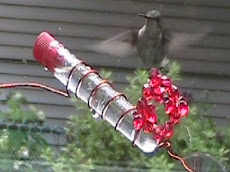
Pictures of our FOTOFEEDER in Grafton, WI.
They are in a holding pattern to get to the feeder!
2010-08-18
New Hummer Feeders
Hi folks,
Not long ago, I purchased some of John's hummer feeder refills. Once they arrived, I decided to go ahead and use some 12 gauge copper wire I had from another project and "wire a couple of them up".
 |
| Taken from the outside |
The photos you see here are the result. I decided to put them on our kitchen window to see how soon they discover them.
 |
| Looking out the kitchen window! |
I'm hoping the hummers around here decide they like them as much or better than the old feeders they've been use to:
As the hummers find these and start to drink from them, I'll post some of the photos I get of them.
'Til then, I hope you have a chance to enjoy your own wonderous hummers!
~Rob~
2010-08-16
Bees and Wasps!
It is now the height of hummer around my area and unfortunately the bees and wasps are keeping my babies away. So I decided to move the main pole with my hummers favorites feeders and about 15 feet away put a huge hanging bowl of the sugar mixture open and all the bees and wasps have gone there for the free for all leaving the feeders alone for now. I will update in about a week to let you know how this works. As for the yellow jacket traps, save your money the bowl trick seems to work better. Let me know if any of you have other ideas.
.jpg)
.jpg)
The bowl of yellow jacket nectar...
Hummer News – Vol. 11 – Footnotes - August 2010
Hold the Salt!!!
There are some ideas that are really good ideas and then, there are the ideas that only seem like very good ideas at the time. I wrote about my “Ant Moat Solution” for more traditional hanging hummer feeders the last time, when I suggested using strongly saline water in the moats to discourage small birds from emptying the reservoir by drinking the water. Well, my old days in the chemistry labs should have raised a red flag, but observation has now filled in where initial recollection failed me. Let’s see, salt (NaCl) and copper (Cu)….what does that sound like? Well, together they create an electric current and the interaction between the two, while not dangerous, is certainly corrosive – especially if your water pH is on the acidic side. So, after a heavy rain washed some of the saline out of the reservoirs to drip down the copper hanging feeders, I noticed the start of discoloration on my copper. Again, unless it was very heavy saline for a long time, no structural damage would occur. However, the appearance of the discolored copper is less than desirable. So, for now, I am going to try a very weak saline and see if it still discourages the birds, but won’t continue the discoloration. If not, back to water and diligence to ensure the reservoirs don’t go dry.
Another problem with my described ant moats was using wire coat hangers for the hanging hooks. Of course, steel is also subject to corrosion and would weaken quickly in the constant saline bath of the reservoir. So, if you do want to try to use salt – which poses no issues for glass or plastic feeders, I would recommend using plastic covered wire or pure plastic for the hanging hooks.
A long time Foto Feeder™ user in CA wrote to me suggesting an alternative to ant moats all-together. Tanglefoot® is a product that is sold in many agricultural shops that discourages the ants with a very sticky physical barrier. It comes in tubes like caulking and can be spread over the path ants must follow to get to the feeder. I bought some a few years back, but never applied it because another friend and Tanglefoot user told me it is quite a challenge to keep the sticky stuff only where you want it. But, I guess with extreme caution, it must work, as it is often suggested in the literature I have read on deterring ants. As my friend wrote from CA, it is very important to be sure it is not on any surface where the hummers might land, as it would get on their feet and be difficult for them to remove. I would be very interested to hear any other interesting solutions you might have come up with
Blog
Please remember you are always welcome at the blog as a reader or contributor. I will be happy to include you as a contributor if you just send me an email so I know you are interested.
Happy Hummer August everyone!!
Please let me know if you wish to be removed from this hummer mailing list and I will do so immediately
Copyright 2010, Merritt Communications, Inc. – All Rights Reserved
There are some ideas that are really good ideas and then, there are the ideas that only seem like very good ideas at the time. I wrote about my “Ant Moat Solution” for more traditional hanging hummer feeders the last time, when I suggested using strongly saline water in the moats to discourage small birds from emptying the reservoir by drinking the water. Well, my old days in the chemistry labs should have raised a red flag, but observation has now filled in where initial recollection failed me. Let’s see, salt (NaCl) and copper (Cu)….what does that sound like? Well, together they create an electric current and the interaction between the two, while not dangerous, is certainly corrosive – especially if your water pH is on the acidic side. So, after a heavy rain washed some of the saline out of the reservoirs to drip down the copper hanging feeders, I noticed the start of discoloration on my copper. Again, unless it was very heavy saline for a long time, no structural damage would occur. However, the appearance of the discolored copper is less than desirable. So, for now, I am going to try a very weak saline and see if it still discourages the birds, but won’t continue the discoloration. If not, back to water and diligence to ensure the reservoirs don’t go dry.
Another problem with my described ant moats was using wire coat hangers for the hanging hooks. Of course, steel is also subject to corrosion and would weaken quickly in the constant saline bath of the reservoir. So, if you do want to try to use salt – which poses no issues for glass or plastic feeders, I would recommend using plastic covered wire or pure plastic for the hanging hooks.
A long time Foto Feeder™ user in CA wrote to me suggesting an alternative to ant moats all-together. Tanglefoot® is a product that is sold in many agricultural shops that discourages the ants with a very sticky physical barrier. It comes in tubes like caulking and can be spread over the path ants must follow to get to the feeder. I bought some a few years back, but never applied it because another friend and Tanglefoot user told me it is quite a challenge to keep the sticky stuff only where you want it. But, I guess with extreme caution, it must work, as it is often suggested in the literature I have read on deterring ants. As my friend wrote from CA, it is very important to be sure it is not on any surface where the hummers might land, as it would get on their feet and be difficult for them to remove. I would be very interested to hear any other interesting solutions you might have come up with
Blog
Please remember you are always welcome at the blog as a reader or contributor. I will be happy to include you as a contributor if you just send me an email so I know you are interested.
Happy Hummer August everyone!!
Please let me know if you wish to be removed from this hummer mailing list and I will do so immediately
Copyright 2010, Merritt Communications, Inc. – All Rights Reserved
2010-08-04
Harold, the Handsome, Hummer Stik™ Visitor in Danbury, CT
I was delighted to receive these wonderful shots of Harold, who is a regular visitor at the Hummer Stiks™ deployed by Sue, a friend and repeat customer from Danbury, CT. Best yet, she allowed me to use one of her shots of Harold to vastly improve my listing for these feeders at eBay. The link above will take you there to see if you'd like. A big fat "Thank You" to Sue and, of course, Harold!!


2010-07-27
Hummer News – Vol. 11 – July 2010
Recent Observed Activity
No question about it, around here in New England, July is the start of the highest activity at all locations I have the chance to visit. At home in Massachusetts, the arrival of July marked a very noticeable increase in visits and nectar consumption at all my feeders. This past weekend I enjoyed one of the most intense viewing periods ever, anywhere, at my friend’s home in Watertown, Connecticut. Multiple birds, with many “dust-ups” between aggressive male territory barons and as many as two or three “encroachers” were the norm all weekend long. It was simply mesmerizing, making it difficult to accomplish much outside of the feeder viewing area.
As I write this edition, anticipating our family’s celebration of my mother’s 90th birthday, by the ocean in South Orleans, Massachusetts, I can see several nectar feeders with regular and relaxed visitors, here in the deep heart of summer. At least around here, this is the time of year we wait for when the living is airy and light and our lovely humming jewels are in abundance.
Ant Moat Solution
I envy those of you who report that they never have ant problems with any of their feeders. It is never an issue with my Foto Feeders™ as ants rarely traverse our window panes, but hanging feeders are another story. I have a couple of my four-tube Roseburg™ feeders deployed and ant moats are essential. I am sure many of you use these hanging hooks that incorporate a water barrier in some sort of container suspended between the two ends. I make my own by melting a tiny hole in the bottom half of a plastic drink bottle. I push a length of wire coat hanger through the hole and make a hook at each end. Then, I seal the hole around the wire with hot glue. They work very well, with the exception of one problem I’d had for a long time – chickadees and titmice seem to prefer drinking out of these to all the fresh sparkling water I always provide with the mister and bird baths.
Not a huge problem, but annoying for several reasons. When a hummer is feeding, if a bird lands to drink, it shakes everything and will often discourage the hummer. In really hot weather, evaporation added to bird drinking does empty the cups much faster, requiring diligence I sometimes don’t muster. So, I show up, the cups are empty and the tubes are inundated with ants. Some people suggest using all cooking oil or a layer of cooking oil, which does discourage the birds. However, the first rainstorm splashes the oil all over the nectar tubes below, making a sticky, hard to clean mess.
One afternoon, I really pondered the question and wondered if tea or coffee might discourage them. However, the idea of caffeine powered chickadees and titmice buzzing the ant moats quickly ruled that out. What wouldn’t they like, that wouldn’t hurt them? The answer presented itself and I was taken by the simplicity – salt!! Birds near the ocean do not drink seawater. So, I looked to see if there were any health issues with birds and salt water and, finding none, put the idea in action. I mixed a very concentrated salt solution, added it to the ant moat cups and grabbed a seat to see if my idea would work. Only one titmouse tried more than one sip and each of those was followed by a head shake and spray out. Everyone happily drinks at the provided water now and my ant moats maintenance requirements are a fraction of what they once were
Blog
Please remember you are always welcome at the blog as a reader or contributor. I will be happy to include you as a contributor if you just send me an email so I know you are interested.
Happy Hummer Mid-Summer everyone!!
Copyright 2010, Merritt Communications, Inc. – All Rights Reserved
No question about it, around here in New England, July is the start of the highest activity at all locations I have the chance to visit. At home in Massachusetts, the arrival of July marked a very noticeable increase in visits and nectar consumption at all my feeders. This past weekend I enjoyed one of the most intense viewing periods ever, anywhere, at my friend’s home in Watertown, Connecticut. Multiple birds, with many “dust-ups” between aggressive male territory barons and as many as two or three “encroachers” were the norm all weekend long. It was simply mesmerizing, making it difficult to accomplish much outside of the feeder viewing area.
As I write this edition, anticipating our family’s celebration of my mother’s 90th birthday, by the ocean in South Orleans, Massachusetts, I can see several nectar feeders with regular and relaxed visitors, here in the deep heart of summer. At least around here, this is the time of year we wait for when the living is airy and light and our lovely humming jewels are in abundance.
Ant Moat Solution
I envy those of you who report that they never have ant problems with any of their feeders. It is never an issue with my Foto Feeders™ as ants rarely traverse our window panes, but hanging feeders are another story. I have a couple of my four-tube Roseburg™ feeders deployed and ant moats are essential. I am sure many of you use these hanging hooks that incorporate a water barrier in some sort of container suspended between the two ends. I make my own by melting a tiny hole in the bottom half of a plastic drink bottle. I push a length of wire coat hanger through the hole and make a hook at each end. Then, I seal the hole around the wire with hot glue. They work very well, with the exception of one problem I’d had for a long time – chickadees and titmice seem to prefer drinking out of these to all the fresh sparkling water I always provide with the mister and bird baths.
Not a huge problem, but annoying for several reasons. When a hummer is feeding, if a bird lands to drink, it shakes everything and will often discourage the hummer. In really hot weather, evaporation added to bird drinking does empty the cups much faster, requiring diligence I sometimes don’t muster. So, I show up, the cups are empty and the tubes are inundated with ants. Some people suggest using all cooking oil or a layer of cooking oil, which does discourage the birds. However, the first rainstorm splashes the oil all over the nectar tubes below, making a sticky, hard to clean mess.
One afternoon, I really pondered the question and wondered if tea or coffee might discourage them. However, the idea of caffeine powered chickadees and titmice buzzing the ant moats quickly ruled that out. What wouldn’t they like, that wouldn’t hurt them? The answer presented itself and I was taken by the simplicity – salt!! Birds near the ocean do not drink seawater. So, I looked to see if there were any health issues with birds and salt water and, finding none, put the idea in action. I mixed a very concentrated salt solution, added it to the ant moat cups and grabbed a seat to see if my idea would work. Only one titmouse tried more than one sip and each of those was followed by a head shake and spray out. Everyone happily drinks at the provided water now and my ant moats maintenance requirements are a fraction of what they once were
Blog
Please remember you are always welcome at the blog as a reader or contributor. I will be happy to include you as a contributor if you just send me an email so I know you are interested.
Happy Hummer Mid-Summer everyone!!
Copyright 2010, Merritt Communications, Inc. – All Rights Reserved
2010-06-23
Hummer News – Vol. 10 – June 2010
Mr. Clockwork
It seems like each year, after a May appearance, for a little while, our hummers disappear, more or less, until late June or early July. After that until late September or early October visits and activity are pretty regular. Don’t really know why that is true, since another Foto Feeder™ user here in town has had regular visits throughout. Thankfully, my quiet period seems to have ended three or four days ago, with ample appearances throughout the day.
Fortunately, I had one handsome male, with prominent scarlet neck band always visible, that showed up every day, even when there were no other visitors. The really interesting thing about him was his incredibly consistent time of arrival, every evening just about five minutes before it got too dark to see him at the window. As the sunset became later, he would adjust by as many minutes, so that it would literally be possible to set your watch by his appearance. He’s probably around at dusk too, but I’m not most days.
Mister Update
I have never received as many responses to any Hummer News topic as I did about the use of misters and the way all our birds love them, including the hummers. Just two days ago, during about three warm afternoon hours, I observed robins, catbirds, blue jays, titmice, downy woodpeckers, goldfinches, chickadees, cardinals, sparrows and hummers spend time in the mister, most long enough to thoroughly shower, drink from leaves and fluff up.
Several of you asked for places to buy a mister, so I did a little research for places that sell them. Here are some links you can try:
Here are some links:
http://www.duncraft.com/Super-Easy-Water-Mister--P2742C0.aspx - Duncraft
http://www.wildbirdsforever.com/access.html - Wild Birds Forever
http://www.shopwbu.com/products/productdetail/part_number=1516/567.0.1.1 – Wild Birds Unlimited (where I got my misters).
Use the lowest pressure that will just start the mist and make sure it hits some leaves nearby to form the drips your visitors will love to drink or rub their faces in. If the drips can finally fall into a birdbath, you will have an interesting and active water feature for your birds and for your viewing enjoyment.
I hope you will share any experience you have with your misters.
Nectar Refresher
As there are almost always questions about nectar recipes, so let me review some things on that topic. First, I use pure, refined white sugar only without color or additives. I do not boil my water first as any sterility that is gained by wasting time and energy on boiling will be lost the instant your first hummer feeds because of the natural bacteria they carry on their tongues and beaks. Honey contains bacteria and raw sugar contains high levels of iron that are harmful. Red coloring is controversial with many claims of causing harm to hummers being made, so I decline to use it to be on the safe side. Snopes, which is pretty good, in my experience, at getting to the bottom of and de-bunking urban legends and other questionable “facts” state that the validity of the concern is undetermined here:
http://www.snopes.com/critters/wild/reddye.asp
Since I’ve never heard anything negative about pure, white refined sugar and it is cheaper and easier to mix, it seems an easy choice to me. I put one cup of sugar in a one quart glass measuring cup. I run my tap water to its hottest temperature and then run a thin trickle into the sugar, mixing briskly from the very beginning with a long handled spoon, up to the full quart. I have never failed to dissolve the full cup of sugar, though even if there were some crystals left un-dissolved in the bottom, that doesn’t harm anything. Extra nectar keeps quite a while in a tightly closed container in the fridge.
Blog Additions
You continue to contribute wonderful links for the blog and I need to get some more up soon, including a magnificent PBS Nature episode devoted to hummers – check in often, as I will add things as often as I can and always welcome you to do the same
Find the blog here: http://hummerhaven.blogspot.com/
Happy Hummer Summer everyone!!
Copyright 2010, Merritt Communications, Inc. – All Rights Reserved
It seems like each year, after a May appearance, for a little while, our hummers disappear, more or less, until late June or early July. After that until late September or early October visits and activity are pretty regular. Don’t really know why that is true, since another Foto Feeder™ user here in town has had regular visits throughout. Thankfully, my quiet period seems to have ended three or four days ago, with ample appearances throughout the day.
Fortunately, I had one handsome male, with prominent scarlet neck band always visible, that showed up every day, even when there were no other visitors. The really interesting thing about him was his incredibly consistent time of arrival, every evening just about five minutes before it got too dark to see him at the window. As the sunset became later, he would adjust by as many minutes, so that it would literally be possible to set your watch by his appearance. He’s probably around at dusk too, but I’m not most days.
Mister Update
I have never received as many responses to any Hummer News topic as I did about the use of misters and the way all our birds love them, including the hummers. Just two days ago, during about three warm afternoon hours, I observed robins, catbirds, blue jays, titmice, downy woodpeckers, goldfinches, chickadees, cardinals, sparrows and hummers spend time in the mister, most long enough to thoroughly shower, drink from leaves and fluff up.
Several of you asked for places to buy a mister, so I did a little research for places that sell them. Here are some links you can try:
Here are some links:
http://www.duncraft.com/Super-Easy-Water-Mister--P2742C0.aspx - Duncraft
http://www.wildbirdsforever.com/access.html - Wild Birds Forever
http://www.shopwbu.com/products/productdetail/part_number=1516/567.0.1.1 – Wild Birds Unlimited (where I got my misters).
Use the lowest pressure that will just start the mist and make sure it hits some leaves nearby to form the drips your visitors will love to drink or rub their faces in. If the drips can finally fall into a birdbath, you will have an interesting and active water feature for your birds and for your viewing enjoyment.
I hope you will share any experience you have with your misters.
Nectar Refresher
As there are almost always questions about nectar recipes, so let me review some things on that topic. First, I use pure, refined white sugar only without color or additives. I do not boil my water first as any sterility that is gained by wasting time and energy on boiling will be lost the instant your first hummer feeds because of the natural bacteria they carry on their tongues and beaks. Honey contains bacteria and raw sugar contains high levels of iron that are harmful. Red coloring is controversial with many claims of causing harm to hummers being made, so I decline to use it to be on the safe side. Snopes, which is pretty good, in my experience, at getting to the bottom of and de-bunking urban legends and other questionable “facts” state that the validity of the concern is undetermined here:
http://www.snopes.com/critters/wild/reddye.asp
Since I’ve never heard anything negative about pure, white refined sugar and it is cheaper and easier to mix, it seems an easy choice to me. I put one cup of sugar in a one quart glass measuring cup. I run my tap water to its hottest temperature and then run a thin trickle into the sugar, mixing briskly from the very beginning with a long handled spoon, up to the full quart. I have never failed to dissolve the full cup of sugar, though even if there were some crystals left un-dissolved in the bottom, that doesn’t harm anything. Extra nectar keeps quite a while in a tightly closed container in the fridge.
Blog Additions
You continue to contribute wonderful links for the blog and I need to get some more up soon, including a magnificent PBS Nature episode devoted to hummers – check in often, as I will add things as often as I can and always welcome you to do the same
Find the blog here: http://hummerhaven.blogspot.com/
Happy Hummer Summer everyone!!
Copyright 2010, Merritt Communications, Inc. – All Rights Reserved
2010-05-28
Hummer News – Vol. 9 – May 2010 – Footnotes
Misters – Just “Blissing” the Day Away
I want to share some recent long and satisfying visits by my local hummers to the mister I run daily with just the first hint of mist and lots of drips. I have used misters for quite a while, after learning how much so many bird species enjoy the water feature. Around here, in addition to hummers, cardinals, goldfinches, chickadees, catbirds and downy woodpeckers are frequent and lengthy visitors. But, just about all species visit from time to time. I have it placed in a leafy bush with the drops from the leaves falling into a birdbath. Lately very hot days have increased the attraction of this cool and refreshing corner of the yard.
The only way I can describe the behavior of the mister patrons is completely “blissing out” in an absolutely “care-less” way. That is exactly what the male and female hummers have been doing. In visits of 5-10 minutes at a time, a very long visit here, they hover in the light mist, rub their bills, faces and bodies across wet leaves – pausing to sip drops of water off the tips of leaves. They perch, in the mist, to stretch and preen their legs and wings without regard to anything going on around them. With the late afternoon sun filtering through the mist and sparkling leaves, the scene is genuinely magical, deeply peaceful and centering to see. I honestly believe that there is no product of any kind more attractive to birds than a simple mister and the miniscule amount of water used at the barely misting low level I set it at. If you haven’t tried, especially in the warmer states, I strongly recommend it. If you have experience with misters, I’d love to hear your story, or better yet, read it at the blog.
Milestone for Merrcomm
It is truly humbling to have been so well received in the first 18 months, after creating the Hummer Foto Feeder™ and offering it on eBay, that I can report my 500th sale. Not large at all by eBay standards of course, but not so bad for a guy making feeders in his back yard to attract the birds we all love. Those sales have been in 47 states and 3 foreign countries. But, I have to say, those three states have been hold outs for a while now and it would be so nice to be in every state. So, if you have friends, family or colleagues in ID, WV or WY, who are interested hummingbirds, maybe you can pass the word and help me close the state gap. I sure would appreciate it.
Copyright 2010, Merritt Communications, Inc. – All Rights Reserved
I want to share some recent long and satisfying visits by my local hummers to the mister I run daily with just the first hint of mist and lots of drips. I have used misters for quite a while, after learning how much so many bird species enjoy the water feature. Around here, in addition to hummers, cardinals, goldfinches, chickadees, catbirds and downy woodpeckers are frequent and lengthy visitors. But, just about all species visit from time to time. I have it placed in a leafy bush with the drops from the leaves falling into a birdbath. Lately very hot days have increased the attraction of this cool and refreshing corner of the yard.
The only way I can describe the behavior of the mister patrons is completely “blissing out” in an absolutely “care-less” way. That is exactly what the male and female hummers have been doing. In visits of 5-10 minutes at a time, a very long visit here, they hover in the light mist, rub their bills, faces and bodies across wet leaves – pausing to sip drops of water off the tips of leaves. They perch, in the mist, to stretch and preen their legs and wings without regard to anything going on around them. With the late afternoon sun filtering through the mist and sparkling leaves, the scene is genuinely magical, deeply peaceful and centering to see. I honestly believe that there is no product of any kind more attractive to birds than a simple mister and the miniscule amount of water used at the barely misting low level I set it at. If you haven’t tried, especially in the warmer states, I strongly recommend it. If you have experience with misters, I’d love to hear your story, or better yet, read it at the blog.
Milestone for Merrcomm
It is truly humbling to have been so well received in the first 18 months, after creating the Hummer Foto Feeder™ and offering it on eBay, that I can report my 500th sale. Not large at all by eBay standards of course, but not so bad for a guy making feeders in his back yard to attract the birds we all love. Those sales have been in 47 states and 3 foreign countries. But, I have to say, those three states have been hold outs for a while now and it would be so nice to be in every state. So, if you have friends, family or colleagues in ID, WV or WY, who are interested hummingbirds, maybe you can pass the word and help me close the state gap. I sure would appreciate it.
Copyright 2010, Merritt Communications, Inc. – All Rights Reserved
2010-05-27
Wonderful Webcam of Two Hummer Hatchlings by Phoebe Allen
Thanks to Sue, my neighbor to the south in CT for sharing this amazing site with us!
http://www.ustream.tv/hummingbirdnestcam
On Ustream
http://www.facebook.com/pages/Phoebe-Allens-Hummingbird-Webcam/119799518053054?ref=ts#!/pages/Phoebe-Allens-Hummingbird-Webcam/119799518053054?v=info&ref=ts
Phoebe's facebook
http://www.phoebeallens.com/
Webcam address from facebook
http://www.ustream.tv/hummingbirdnestcam
On Ustream
http://www.facebook.com/pages/Phoebe-Allens-Hummingbird-Webcam/119799518053054?ref=ts#!/pages/Phoebe-Allens-Hummingbird-Webcam/119799518053054?v=info&ref=ts
Phoebe's facebook
http://www.phoebeallens.com/
Webcam address from facebook
2010-05-17
Visits to Hummer Foto Feeders™ Reported in Wallingford, CT and Islesboro, ME
A new Hummer Foto Feeder™ user in Wallingford, CT had the first visits of this season on Friday. My uncle, who has used his feeders for two previous seasons, had his first visits yesterday. So, it is looking good pretty far up the east coast now.
2010-05-09
They're Here! They're Here! - Hummer News – Vol. 9 – May 2010
At 5:30 pm yesterday, a thunderstorm that had darkened late afternoon to twilight finally began to wane. Low sunlight began to filter through the end of the storm and the maple leaves, finally warming to golden, as the wet surfaces of everything sparkled like prisms. At 5:48, two days earlier than last year, I observed my first hummer visitor at the backyard Roseburg™ feeder. She checked three of the four nectar tubes in less than 45 seconds and was gone. All that was left was the ruby hued glimmering of the attractor beads in the still lower sunlight and the smile on my face knowing that my spring had, in fact, finally arrived. Another, longer, Mother’s Day visit and nectar tubes emptying added additional warmth and cheer to a day that topped out here at only about 52 degrees. So, in eastern Massachusetts, the season has finally begun! I would love to hear about your neighborhood.
Happy Hummers – Hooray, they are here!
Copyright 2010, Merritt Communications, Inc. – All Rights Reserved
Happy Hummers – Hooray, they are here!
Copyright 2010, Merritt Communications, Inc. – All Rights Reserved
2010-04-26
Hummingbird feeder
I just want to tell all you hummingbird lovers you need to go to Jam's e-bay site (merrcomm) and get the Nectar Storage Dispenser Bottle, I just used mine Sunday for the first time and I can tell you it is the best thing to fill all the tubes I have, it is wonderful, I also used the brush set he has on his e-bay site and they really made cleaning up all the tubes and caps so much easier, no more spilled nectar from the measuring cup I had been using, summer is here, yea!! Phyllis
2010-04-21
Hummer News – Vol. 8 – April 2010
With fairly strange, often wet and suddenly warm weather earlier this month, everything around here suddenly seems to be about two to three weeks ahead with respect to trees and shrubs blossoming out. Since my earliest hummer sighting last spring was on May 10th, I used Monday’s unique Massachusetts holiday, Patriot’s Day (when the Boston Marathon is run, starting about 12 miles down the road from me and running right through downtown) to place about 25% of my nectar feeders around the yard. So far no evidence of any visits, but I expect action just about any day now. I hope spring in your area brings an explosion of leaves and blooms, as well as yardfuls of hummingbirds.
Your Visits and Photographs
As always, I remain extremely interested to hear from you about when your visits start or how busy your feeders are. In addition, nothing makes me happier than receiving photos and videos from you as you document the comings and goings of our tiny friends. The blog is always open to anyone that has anything at all they would like to share with the rest of us.
My Broken Record Observation
If you haven’t already done so, now would be a very good time to clean all bird feeders, not only your hummer feeders with a mild, 10% bleach solution and a good rinse before the season begins. For you year round folks, spring would always be a good time to do a thorough clean-up, as well as several other times each year. Anytime that any black residue is building up on any nectar feeder or part, it is essential for the health of your visitors to give everything a good scrubbing.
Product Feedback Always Welcomed and Encouraged
I am especially interested to hear any feedback from recent customers who have purchased any MerrComm hummingbird products, now including the Hummer Foto Feeder™ the Hummer Stik™ hand held feeder, a Nectar Tube cleaning brush set or Nectar storage and dispensing bottle. I want all of these products to be the best I can make them and your feedback is a very important component to in helping me accomplish that.
Our blog awaits and welcomes you…
Please visit your blog Hummingbird Haven and better yet, please jump in. I have just posted a new video from southern California and will be putting up the fact and instruction sheets for all the current products. If you’ve lost the email inviting you to be a fully enabled post author, just drop me an email and I will send a new one. Just reply to that invitation and join the fun. Find the blog here: http://hummerhaven.blogspot.com/
Happy Hummers and a big warm welcome to Spring!
Copyright 2010, Merritt Communications, Inc. – All Rights Reserved
Your Visits and Photographs
As always, I remain extremely interested to hear from you about when your visits start or how busy your feeders are. In addition, nothing makes me happier than receiving photos and videos from you as you document the comings and goings of our tiny friends. The blog is always open to anyone that has anything at all they would like to share with the rest of us.
My Broken Record Observation
If you haven’t already done so, now would be a very good time to clean all bird feeders, not only your hummer feeders with a mild, 10% bleach solution and a good rinse before the season begins. For you year round folks, spring would always be a good time to do a thorough clean-up, as well as several other times each year. Anytime that any black residue is building up on any nectar feeder or part, it is essential for the health of your visitors to give everything a good scrubbing.
Product Feedback Always Welcomed and Encouraged
I am especially interested to hear any feedback from recent customers who have purchased any MerrComm hummingbird products, now including the Hummer Foto Feeder™ the Hummer Stik™ hand held feeder, a Nectar Tube cleaning brush set or Nectar storage and dispensing bottle. I want all of these products to be the best I can make them and your feedback is a very important component to in helping me accomplish that.
Our blog awaits and welcomes you…
Please visit your blog Hummingbird Haven and better yet, please jump in. I have just posted a new video from southern California and will be putting up the fact and instruction sheets for all the current products. If you’ve lost the email inviting you to be a fully enabled post author, just drop me an email and I will send a new one. Just reply to that invitation and join the fun. Find the blog here: http://hummerhaven.blogspot.com/
Happy Hummers and a big warm welcome to Spring!
Copyright 2010, Merritt Communications, Inc. – All Rights Reserved
2010-03-11
Hummer News – Vol. 7 – March 2010
Hummer News – Vol. 7 – March 2010
Time to prepare all your feeders and nectar tubes
If you haven’t already done so, now would be a very good time to clean all bird feeders, not only your hummer feeders with a mild, 10% bleach solution and a good rinse before the season begins. For you year round folks, spring would always be a good time to do a thorough clean-up, as well as several other times each year. Anytime that any black residue is building up on any nectar feeder or part, it is essential for the health of your visitors to give everything a good scrubbing.
MerrComm Product Feedback Welcomed and Strongly Encouraged
I am especially interested to hear any feedback from recent customers who have purchased a Roseburg™ 4-tube feeder, a Hummer Stik™ hand held feeder, a Nectar Tube cleaning brush set or Nectar storage and dispensing bottle. I want all of these products to be the best I can make them and your feedback is a very important component to in helping me accomplish that.
Our blog awaits and welcomes you…
Please visit your blog Hummingbird Haven and better yet, please jump in. I have just posted a new video from southern California and will be putting up the fact and instruction sheets for all the current products. If you’ve lost the email inviting you to be a fully enabled post author, just drop me an email and I will send a new one. Just reply to that invitation and join the fun. Find the blog here: http://hummerhaven.blogspot.com/
Happy Hummers and Sweet Dreams of Spring, just around the corner until the next time…
Copyright 2010, Merritt Communications, Inc. – All Rights Reserved
Another Reason To Wish I Were in Southern California
Ronnie, a brand new Hummer Foto Feeder™ customer from Riverside, CA sent in this video of one of their brand new little visitors…
Subscribe to:
Posts (Atom)