Hummer Foto Feeder™
All Products are Here
2011-06-27
Wonderful Alaskan Hummer Video - Check It Out!!
Thank you to Bonnie, a customer from "Cloudy but 80 degrees Oregon" who sent along this fantastic video about drawing some Alaskan Hummers up really close and personal…


2011-05-24
Spring is here! (At least the birds think so!)
Yep, Spring is officially here - although here in Washington State, we're all wondering about that! The birds, however, have embraced the time of year with their courting & nesting activities. I've actually got a pair of chickadees nesting in one of my bird houses! The first time in years one of my birdhouses has been "rented".
We've also been visited by the cute hummers. The first one showed up about a month ago, then disappeared again. Now, we've got a pair of them coming by fairly regularly. The funny thing is they seem to prefer my mother's old feeder. (It's about 15 years old, by now!) This is one of the ones that is designed like a hot-air balloon. I've got some newer ones, along with the small tubes, but they seem to be all but ignored.
Another thing I noticed, is one of the frequent feeders at Mom's feeder is a Purple Finch! I must say, it looks a bit odd, seeing that large bird (compared to a hummer) sitting and drinking from the hummer feeder!
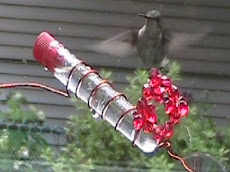
About the tube feeders, I keep experimenting to see what will actually attract the hummers to them, but so far, haven't had any success. I'm going to try to attach one to one of our bushes to see if that'll work. Then maybe the hummer will come drink from the one I've got suction-cupped to our kitchen window!
Time will tell.
Well, folks, enjoy all the wonderful birds that Spring brings, especially those gorgeous Hummers!
~Rob~
We've also been visited by the cute hummers. The first one showed up about a month ago, then disappeared again. Now, we've got a pair of them coming by fairly regularly. The funny thing is they seem to prefer my mother's old feeder. (It's about 15 years old, by now!) This is one of the ones that is designed like a hot-air balloon. I've got some newer ones, along with the small tubes, but they seem to be all but ignored.
Another thing I noticed, is one of the frequent feeders at Mom's feeder is a Purple Finch! I must say, it looks a bit odd, seeing that large bird (compared to a hummer) sitting and drinking from the hummer feeder!
About the tube feeders, I keep experimenting to see what will actually attract the hummers to them, but so far, haven't had any success. I'm going to try to attach one to one of our bushes to see if that'll work. Then maybe the hummer will come drink from the one I've got suction-cupped to our kitchen window!
Time will tell.
Well, folks, enjoy all the wonderful birds that Spring brings, especially those gorgeous Hummers!
~Rob~
2011-05-17
Hummer News - Vol. 15 - May 2011
At last!!!
After a longer wait than most springs, I finally eyeballed my first hummer visitor of 2011, here in New England . I am reasonably sure it was a male that has been coming for at least three years now. Unlike many other males, this fellow is extremely furtive and makes all of his visits at dawn and dusk, when the level of light is very low. Further evidence of it being this particular male is the feeder he chose. It is a very early proto-type of my Foto-Feeder™ that has been in the same exact spot for quite a few years now. Very likely there are others about and that the first visits were probably as much as a week earlier, since nectar in two or three of my feeder tubes, at a few locations, already seemed to be reducing by very small amounts.
After so many years, the first hummer visit witnessed is still such a special moment. In spite of our dismal wet and cold spring so far, the warmth of a season, as yet unrealized seems closer and more promising now. This year, after winter travel in warm climes full of hummers, seeing my first “home bird” bridges my first ever 12 month cycle being able to view hummers live. I have always envied those of you who always have a year round presence. Since they are here now, I expect just about all of you have had your first visits now. I wish everyone a great spring and summer with lots of visits and maybe a nesting family. That is something I would really like to experience live.
I hope you will share how the hummer sightings are, currently, in your region.
Spring cleaning
While most of you are already finished with this step by now, it is a good idea to do a thorough cleaning of nectar tubes and caps. I use a 10% bleach solution to nicely sanitize all my tubes before setting out.
I welcome you all to share any hummer sightings or stories that we all might enjoy here at the blog. Just drop an email note and I will send an invitation to become a contributor
Happy Hummers and a Great Late Springtime!
Copyright 2011, Merritt Communications – All Rights Reserved
Can anyone identify these hummers?
Barry Aronoff, a customer in Pasadena, California, who is also an excellent photographer, sent these shots along and wondered if I could help identify the hummer varieties. If you have any ideas, please share them with us. The best I could come up with is that the really beautiful one on the pine looks like it could be the Xanthus perhaps - apparently a little bit off its beaten path - it is listed as rare in Califonia - this may be very rare shot indeed! Here is a link for Xanthus: http://www.hummingbirds.net/xantus.html


This shot isn't a hummer but is such a nice shot I thought it was well worth including anyway...


This shot isn't a hummer but is such a nice shot I thought it was well worth including anyway...


2011-01-01

2010-11-23
Hummingbirds: Magic in the Air - PBS Nature Episode
So many have emiled and mentioned this spectacular PBS episode of Nature featuring our favorite flying jewels. If you haven't seen it, it is a must see - especially the way the flora actually impacts the evolution of our friends. If you have seen it, by all means pass it on to friends and family. I have never heard from anyone that was not completely charmed by the interesting and educational special.


Hummer News - Vol. 14 - November 2010
Giving Thanks…
Even though it will be many months before I see a hummer in my yard again, I am thankful for a season full of visitors, as I do a final cleaning of all my nectar tubes and caps. Making sure everything is ready will help it seem sooner. If you haven’t already, use a 10% bleach solution to nicely sanitize all your tubes before laying aside for next spring.
I am thankful for all of you who have joined our hummer loving family and also for the contributions to all of our understanding them better with blog entries and emails – also for the gentle prods wondering why there hadn’t been and Hummer News for a while…
I wish each of you and yours a joyous, peaceful and warm holiday season where ever you may be...
Recent Travel and Hummer Sightings
I had the opportunity to spend some time on the Dutch and French Caribbean island of St. Maarten/St. Martin, where I saw two species of hummers I never see. Just about everywhere one could see either the Crested Antillean or Emerald Throated Carib hummingbird. The first is a somewhat uncommon, crested, hummer variety that is quite dark in color. The latter is electric green, with a tail that fades from green to electric blue, ending in black, truly jewel-like in the island sunshine. I am posting a picture of each here. It was a very nice revisiting of the season lost back home, though one could get quite spoiled with the sheer number of birds and sightings there.
I welcome you all to share any hummer sightings or stories that we all might enjoy at the blog.
Blog invitation…
Please remember you are always welcome at the blog as a reader, commenter or full-privileged contributor. I will be happy to invite you as a contributor if you just send me an email so I know you are interested.
Find the blog here: http://hummerhaven.blogspot.com/
Have a Holiday of Hummer dreams!!
Copyright 2010, Merritt Communications, Inc. – All Rights Reserved
Even though it will be many months before I see a hummer in my yard again, I am thankful for a season full of visitors, as I do a final cleaning of all my nectar tubes and caps. Making sure everything is ready will help it seem sooner. If you haven’t already, use a 10% bleach solution to nicely sanitize all your tubes before laying aside for next spring.
I am thankful for all of you who have joined our hummer loving family and also for the contributions to all of our understanding them better with blog entries and emails – also for the gentle prods wondering why there hadn’t been and Hummer News for a while…
I wish each of you and yours a joyous, peaceful and warm holiday season where ever you may be...
Recent Travel and Hummer Sightings
I had the opportunity to spend some time on the Dutch and French Caribbean island of St. Maarten/St. Martin, where I saw two species of hummers I never see. Just about everywhere one could see either the Crested Antillean or Emerald Throated Carib hummingbird. The first is a somewhat uncommon, crested, hummer variety that is quite dark in color. The latter is electric green, with a tail that fades from green to electric blue, ending in black, truly jewel-like in the island sunshine. I am posting a picture of each here. It was a very nice revisiting of the season lost back home, though one could get quite spoiled with the sheer number of birds and sightings there.
I welcome you all to share any hummer sightings or stories that we all might enjoy at the blog.
Blog invitation…
Please remember you are always welcome at the blog as a reader, commenter or full-privileged contributor. I will be happy to invite you as a contributor if you just send me an email so I know you are interested.
Find the blog here: http://hummerhaven.blogspot.com/
Have a Holiday of Hummer dreams!!
Copyright 2010, Merritt Communications, Inc. – All Rights Reserved
2010-09-23
Risk to Hummers from the Praying Mantis - Read Warning First!
I try to keep the emphasis here on the positive and joyful. But, a friend and fellow eBay seller, Grandma Darlene, sent me a link to a difficult and gruesome story to read. However, because in many areas the praying mantis is a common insect, I felt I had to pass this on. WARNING - if there are never praying mantises near you, I would avoid reading this story. But, these insects pose a very real risk to our dear little visitors if they are present in your region. You can also skip checking this link and just try to keep them as far away as possible from any feeders you may have. Well, now that you have all the warnings...if you want to read about this the link is here:
http://www.birdwatchersdigest.com/site/backyardbirds/hummingbirds/mantis-hummer.aspx
http://www.birdwatchersdigest.com/site/backyardbirds/hummingbirds/mantis-hummer.aspx
2010-09-03
New User with a Wonderful Job!
I just learned that one of my newest customers, from the Atlanta, GA area, has a really great job - bird rehabilitator. Most of the patients come from a local wildlife facility or an emergency vetinary clinic. The picture below is of one of the newest charges - a baby hummer. I am hopeful that we may get further updates in the future relating to this wonderful work. After a slow start, this hummer is active and flying around happily at about 1/2 of adult size...


Hummer News – Vol. 13 – September 2010
That time of year...
.
I did everything I could to avoid the inevitable – I turned all the calendars, that faced outside windows, around in the hopes my daily visitors would miss the turn from August to September and freshened every nectar tube every day…Nonetheless, in the course of about five days or so after I last wrote about the most copious visits ever, all the activity here has dwindled to a very low rate. In addition, just like LuvHummers observed on the blog, the incredible numbers of yellow jackets just plain disappeared. I know my visitors need to leave each year to be safe and be able to return next year and I also know that for a while, I will have a lot of vagabonds on their way home from farther north. It’s not over for quite a few weeks yet here, but I start to envy those of you who have the year round seasons. But, I suppose having something to look forward to through the long cold winter. Hurricane Earl is due around here later tonight, but should only be a category one hurricane or possibly just a tropical storm by the time it arrives.
The hummers that are still around are enjoying lots of hibiscus blooms, as well as a couple of fully blossomed butterfly bushes. So, it is a quieter time now and I guess that’s not bad either as we settle into the last weeks of astronomical summer, even as the Labor Day weekend signals the return to schools and offices for many. I hope you all enjoy a safe, peaceful and fun weekend, as we enter this time of transition.
Blog invitation…
Please remember you are always welcome here at the blog as a reader, commenter or full-privileged contributor. I will be happy to invite you as a contributor if you just send me an email so I know you are interested.
Soak in our late summer Hummer experiences!!
Copyright 2010, Merritt Communications, Inc. – All Rights Reserved
2010-08-28
Hummers in Oregon
Hi, I still have a lot of hummers in Roseburg, Oregon, I don't have much problem with bee's as I turn my feeding tubes up so the nector is not right on the cap so they can't get much and the hummers can reach their tongue down into the tube a long ways. It is so easy to refill them with the plastic bottle I got from envirojam and it takes me half the time it used to. So if you haven't gotten one yet I would say you should do it now.
2010-08-22
Hummer News – Vol. 12 – August 2010
Why We Do It All…
Between 7:00 and 8:30 am yesterday morning I luxuriated in hummer activity more varied and constant than I may have ever experienced before here at home. First, when my eyes first opened, I saw a hummer feeding at my second story, bedroom window, and right over my pillow. After she left, I turned and looked down into the yard under my window and immediately spied an active male visiting freshly blossomed weeds I can’t even name.
So, I went out to the yard and, during the next ninety minutes, the reason for the season’s many hours of preparation and maintenance was made abundantly clear. As we approach September, I am guessing that we are beginning to see migrators from the far north begin to pass through again for the first time since early spring because of the increased number of birds exhibiting “curiosity” behavior as they check out flowers, feeders and the rest. I witnessed virtually non-stop visits at all my feeders, as well as lots of visits to the hibiscus, butterfly bushes and the mister. Because of our extended drought conditions, the mister has been especially popular. I returned into the house for breakfast, after my extended and magical hummer meditations, peaceful, refreshed and spiritually uplifted. What better was is there to start the day than that?
Blog Activity
Thanks to the contributions of both old and new members of our hummer family, this blog has some great new entries. Among them are some ideas for managing yellow jackets and wasps, a perennial problem this time of year in many areas. I can say I have tried a couple ideas and am finding great success so far. So, I urge you to check out the recent posts and comments that follow below.
Please remember you are always welcome at this blog as a reader, commenter or full-privileged contributor. I will be happy to invite you as a contributor if you just send me an email so I know you are interested.
May you all also have august, August Hummer experiences!!
Copyright 2010, Merritt Communications, Inc. – All Rights Reserved
Between 7:00 and 8:30 am yesterday morning I luxuriated in hummer activity more varied and constant than I may have ever experienced before here at home. First, when my eyes first opened, I saw a hummer feeding at my second story, bedroom window, and right over my pillow. After she left, I turned and looked down into the yard under my window and immediately spied an active male visiting freshly blossomed weeds I can’t even name.
So, I went out to the yard and, during the next ninety minutes, the reason for the season’s many hours of preparation and maintenance was made abundantly clear. As we approach September, I am guessing that we are beginning to see migrators from the far north begin to pass through again for the first time since early spring because of the increased number of birds exhibiting “curiosity” behavior as they check out flowers, feeders and the rest. I witnessed virtually non-stop visits at all my feeders, as well as lots of visits to the hibiscus, butterfly bushes and the mister. Because of our extended drought conditions, the mister has been especially popular. I returned into the house for breakfast, after my extended and magical hummer meditations, peaceful, refreshed and spiritually uplifted. What better was is there to start the day than that?
Blog Activity
Thanks to the contributions of both old and new members of our hummer family, this blog has some great new entries. Among them are some ideas for managing yellow jackets and wasps, a perennial problem this time of year in many areas. I can say I have tried a couple ideas and am finding great success so far. So, I urge you to check out the recent posts and comments that follow below.
Please remember you are always welcome at this blog as a reader, commenter or full-privileged contributor. I will be happy to invite you as a contributor if you just send me an email so I know you are interested.
May you all also have august, August Hummer experiences!!
Copyright 2010, Merritt Communications, Inc. – All Rights Reserved
2010-08-21
Grafton,WI


Pictures of our FOTOFEEDER in Grafton, WI.
They are in a holding pattern to get to the feeder!
2010-08-18
New Hummer Feeders
Hi folks,
Not long ago, I purchased some of John's hummer feeder refills. Once they arrived, I decided to go ahead and use some 12 gauge copper wire I had from another project and "wire a couple of them up".
 |
| Taken from the outside |
The photos you see here are the result. I decided to put them on our kitchen window to see how soon they discover them.
 |
| Looking out the kitchen window! |
I'm hoping the hummers around here decide they like them as much or better than the old feeders they've been use to:
As the hummers find these and start to drink from them, I'll post some of the photos I get of them.
'Til then, I hope you have a chance to enjoy your own wonderous hummers!
~Rob~
2010-08-16
Bees and Wasps!
It is now the height of hummer around my area and unfortunately the bees and wasps are keeping my babies away. So I decided to move the main pole with my hummers favorites feeders and about 15 feet away put a huge hanging bowl of the sugar mixture open and all the bees and wasps have gone there for the free for all leaving the feeders alone for now. I will update in about a week to let you know how this works. As for the yellow jacket traps, save your money the bowl trick seems to work better. Let me know if any of you have other ideas.
.jpg)
.jpg)
The bowl of yellow jacket nectar...
Hummer News – Vol. 11 – Footnotes - August 2010
Hold the Salt!!!
There are some ideas that are really good ideas and then, there are the ideas that only seem like very good ideas at the time. I wrote about my “Ant Moat Solution” for more traditional hanging hummer feeders the last time, when I suggested using strongly saline water in the moats to discourage small birds from emptying the reservoir by drinking the water. Well, my old days in the chemistry labs should have raised a red flag, but observation has now filled in where initial recollection failed me. Let’s see, salt (NaCl) and copper (Cu)….what does that sound like? Well, together they create an electric current and the interaction between the two, while not dangerous, is certainly corrosive – especially if your water pH is on the acidic side. So, after a heavy rain washed some of the saline out of the reservoirs to drip down the copper hanging feeders, I noticed the start of discoloration on my copper. Again, unless it was very heavy saline for a long time, no structural damage would occur. However, the appearance of the discolored copper is less than desirable. So, for now, I am going to try a very weak saline and see if it still discourages the birds, but won’t continue the discoloration. If not, back to water and diligence to ensure the reservoirs don’t go dry.
Another problem with my described ant moats was using wire coat hangers for the hanging hooks. Of course, steel is also subject to corrosion and would weaken quickly in the constant saline bath of the reservoir. So, if you do want to try to use salt – which poses no issues for glass or plastic feeders, I would recommend using plastic covered wire or pure plastic for the hanging hooks.
A long time Foto Feeder™ user in CA wrote to me suggesting an alternative to ant moats all-together. Tanglefoot® is a product that is sold in many agricultural shops that discourages the ants with a very sticky physical barrier. It comes in tubes like caulking and can be spread over the path ants must follow to get to the feeder. I bought some a few years back, but never applied it because another friend and Tanglefoot user told me it is quite a challenge to keep the sticky stuff only where you want it. But, I guess with extreme caution, it must work, as it is often suggested in the literature I have read on deterring ants. As my friend wrote from CA, it is very important to be sure it is not on any surface where the hummers might land, as it would get on their feet and be difficult for them to remove. I would be very interested to hear any other interesting solutions you might have come up with
Blog
Please remember you are always welcome at the blog as a reader or contributor. I will be happy to include you as a contributor if you just send me an email so I know you are interested.
Happy Hummer August everyone!!
Please let me know if you wish to be removed from this hummer mailing list and I will do so immediately
Copyright 2010, Merritt Communications, Inc. – All Rights Reserved
There are some ideas that are really good ideas and then, there are the ideas that only seem like very good ideas at the time. I wrote about my “Ant Moat Solution” for more traditional hanging hummer feeders the last time, when I suggested using strongly saline water in the moats to discourage small birds from emptying the reservoir by drinking the water. Well, my old days in the chemistry labs should have raised a red flag, but observation has now filled in where initial recollection failed me. Let’s see, salt (NaCl) and copper (Cu)….what does that sound like? Well, together they create an electric current and the interaction between the two, while not dangerous, is certainly corrosive – especially if your water pH is on the acidic side. So, after a heavy rain washed some of the saline out of the reservoirs to drip down the copper hanging feeders, I noticed the start of discoloration on my copper. Again, unless it was very heavy saline for a long time, no structural damage would occur. However, the appearance of the discolored copper is less than desirable. So, for now, I am going to try a very weak saline and see if it still discourages the birds, but won’t continue the discoloration. If not, back to water and diligence to ensure the reservoirs don’t go dry.
Another problem with my described ant moats was using wire coat hangers for the hanging hooks. Of course, steel is also subject to corrosion and would weaken quickly in the constant saline bath of the reservoir. So, if you do want to try to use salt – which poses no issues for glass or plastic feeders, I would recommend using plastic covered wire or pure plastic for the hanging hooks.
A long time Foto Feeder™ user in CA wrote to me suggesting an alternative to ant moats all-together. Tanglefoot® is a product that is sold in many agricultural shops that discourages the ants with a very sticky physical barrier. It comes in tubes like caulking and can be spread over the path ants must follow to get to the feeder. I bought some a few years back, but never applied it because another friend and Tanglefoot user told me it is quite a challenge to keep the sticky stuff only where you want it. But, I guess with extreme caution, it must work, as it is often suggested in the literature I have read on deterring ants. As my friend wrote from CA, it is very important to be sure it is not on any surface where the hummers might land, as it would get on their feet and be difficult for them to remove. I would be very interested to hear any other interesting solutions you might have come up with
Blog
Please remember you are always welcome at the blog as a reader or contributor. I will be happy to include you as a contributor if you just send me an email so I know you are interested.
Happy Hummer August everyone!!
Please let me know if you wish to be removed from this hummer mailing list and I will do so immediately
Copyright 2010, Merritt Communications, Inc. – All Rights Reserved
2010-08-04
Harold, the Handsome, Hummer Stik™ Visitor in Danbury, CT
I was delighted to receive these wonderful shots of Harold, who is a regular visitor at the Hummer Stiks™ deployed by Sue, a friend and repeat customer from Danbury, CT. Best yet, she allowed me to use one of her shots of Harold to vastly improve my listing for these feeders at eBay. The link above will take you there to see if you'd like. A big fat "Thank You" to Sue and, of course, Harold!!


Subscribe to:
Posts (Atom)